Tampilkan postingan dengan label VR. Tampilkan semua postingan

Kamis, 27 Agustus 2015

VR - The Rewards ... The Risks -- EXCLUSIVE Interview with Mike Rothenberg of River VR Accelerator

[My interview below first appeared yesterday in VideoInk .]  

Virtual Reality (VR) and Augmented Reality (VR), together “Immersive” technologies are increasingly meaningful actual realities for the business world and not just media and entertainment.  Much is written about the incredible promise and potential power of Immersive technologies for all of us (I too have written several times on that subject).  But, much less is written – at least in the industry press – about the known and, even more importantly, unknown risks associated with full sensory immersion. 

I became intrigued about this topic a few months back when I moderated a VR panel that featured Mike Rothenberg, a VR pioneer who runs the first VR accelerator, the “River Accelerator.”  (Here is a TechCrunch feature story of Mike from a couple years back -- am proud to say that my company's Manatt Venture Fund is an investor in Mike and his VC and Manatt Digital Media is heavily involved in the VR/AR Immersive space).  I recently interviewed Mike on this highly complex, fascinating topic.  Mike is one of VR’s strongest champions – and puts his money directly where his mouth is by financing VR startups through his venture capital firm Rothenberg Ventures.  Here is my interview.

Question (Csathy): Tell me at a high level what led you to not only be champion of VR’s amazing potential, but also a voice of caution with the cause?

Answer (Rothenberg):  I feel a social responsibility to address all aspects of VR given my role within the industry.  Like all great leaps in technology, there are really powerful things that could be positive or negative. VR is an entirely different type of visual medium because it bypasses your biological system to directly affect your memory.  It is not just visual; it is the difference in thinking that you are watching something and thinking you are there, which we call “presence”.

Csathy: Give me some non-obvious examples of Immersive’s potential to do great good.

Rothenberg: Definitely.  DeepStreamVR is a VR startup that helps cope with pain by refocusing attention. Some Washington hospitals have found that they can dramatically reduce the pain that child burn victims experience when changing bandages by immersing them in a VR world of snow.  In the snow world, the mind refocuses and the children report pain reductions comparable that of opiates.  It’s incredible.  Another example is FOVE, a company building a hardware system with eye-tracking software that translates a user’s eye movements to specific action.  An inspirational example of FOVE’s ability to change lives can be seen on its website, where a university student with muscular dystrophy in Japan plays a piano in a live performance using his eyes in a VR headset by looking at the piano keys with eye-tracking software.  Psious is another amazing startup changing lives. Its immersive technology helps people practice coping with fear, whatever they may be.  Fear of flying, fear of heights, etc.  If you can experience that fear in a controlled environment, you can learn to overcome it.  And think of the elderly and others who are immobile and confined to beds.  Now they can be transported anywhere in the world from their bedroom and be constrained only by our imaginations.

Ultimately the power of virtual reality is in its ability enable a permanently higher quality of life.

Csathy: How about on the other end of the spectrum.  What are some non-obvious examples of Immersive’s potential to cause great harm?

Rothenberg:  Watching a war movie makes you think you watched a war movie.  Inside a virtual reality war experience, you may feel like you are actually in a war.  VR could make a very different imprint on your memory and your brain that could lead to actual post-traumatic stress disorder.  If “Pirates of the Caribbean” is rated PG13 just due to the sight of blood, then how do we even begin to rate the potential impact of feeling what it’s like be there if someone cuts off a pirate’s leg right in front of us? We do not yet understand the implications there.  The ability to scar people is greater, and researchers will conduct studies to gauge how real those risks are.  I am not a proponent of blind censorship, but I’m afraid of what we don’t know.  That’s why we are not investing in potentially traumatizing VR.  We simply don’t know the real-life implications of experiencing terrifying content in VR.

Csathy:  In the panel I moderated, you used an example of how VR potentially could be used by terrorists like ISIS to create unimaginable impacts.  Are you aware of anyone yet – any group or company -- who has created VR content specifically designed to harm and cause pain?

Rothenberg:  Not yet, but they will come.

Csathy:  River seems to be mentioned in just about every VR investment conversation.  What is your investment strategy?

Rothenberg:  We invest in the intersection of where the world is going and where we want it to go We form proactive theses around next generation technology like VR, AR, and Artificial Intelligence, as well as invest actively in enterprise software and reactively in consumer.  Then we work with our network of hundreds of founders and startup CEOs to find and invest in the fastest-growing technology startups, most often as their first institutional investor, and help them get to the next stage with the right people for their company.

Csathy:  How would you describe the Immersive world as it is today, compared to where it will be?


Rothenberg:  I think VR in 2015 is like the Internet in 1994 or mobile in 2007.  It’s been in the preseason for decades but now it’s in the first inning.  There’s still so much exploration to be done!  So, although I don’t anticipate society’s immediate mass adoption of VR and AR technology, ultimately it is inevitable.

Rabu, 29 Juli 2015

Disney Accelerator Class of 2015 - My Picks (& Pics of Mentor Open House)

Disney's highly visible tech accelerator -- appropriately named simply the "Disney Accelerator" -- hosted its open house yesterday for Mentors (am proud to be one of them) to meet the incoming Class of 2015.  10 innovative start-ups hand-picked by the Mouse House -- ranging from robotics (Open Bionics enables amputees to use 3D printing to create affordable bionic hands ... how cool is that?), to artificial intelligence (Imperson enables fans to have conversations with their favorite movie and TV characters, or any character period).  (That's me to the left with long-time friend Marc Zachary, a VP of Disney Interactive.)
Given my increasingly immersive focus, my two stand-outs were:

(1) EMOTIV -- a bioinformatics company that uses EEGs to track mental performance, monitor emotions (including stress levels), and control virtual and physical objects with thoughts (that's me to the right demo-ing with CEO Dr. Geoffrey Mackellar).  Imagine the possibilities here?  Massive.  Not only the obvious (such as focus group testing for media companies), but also much wider applications like overall health and wellness (once again, monitoring stress levels as one example); and

(2) Littlstar -- a VR company that aggregates leading virtual reality content with its device-agnostic discovery and distribution platform (think of it kind of like being a "YouTube for VR").  I spent time with CEO Ben Nunez to learn how he plans to compete with YouTube, among others in the burgeoning space.  Others certainly believe in his vision apart from Disney, since Littlstar just recently demo'd at Bertelsmann Digital Media Investment's (BDMI's) Media Summit in NYC a few weeks back.

Rabu, 22 Juli 2015

VR - Not A Separate Category - Rather A Broad New Form of Customer Engagement, Period.

Image result for river virtual reality imageVirtual reality (VR) is rightly top of mind in the media/tech communities - and in my own writing and mentorship.  Virtually all with whom I discuss virtual reality talk about VR like it is a separate and distinct "product" category -- something divorced and distinct from their day-to-day businesses.

Only it isn't -- that's the reality.

VR is -- or certainly will be -- an integrated and integral part of business period.  And of customer engagement and an overall customer experience (not just another media and entertainment immersive experiential story-telling platform).  VR visionary Mike Rothenberg of Rothenberg Ventures -- who puts his money where his mouth is (by funding VR companies through his first-ever VR accelerator, River) -- drove this point home to me in a recent conversation.  He pointed out example after example of VR's broad application in the business world -- architecture, for example (imagine exploring spaces realistically, immersively).

In this holistic way, VR is not unlike the digital video and social worlds that gather later this week at VidCon in Anaheim.  Video and social are not just about story-telling -- not just about media, entertainment and tech.  These are simply new and transformative modes of communication, interaction and engagement.  That means that they are fundamental to any business, including yours and mine.

Worth contemplating, immersively ...

Selasa, 30 Juni 2015

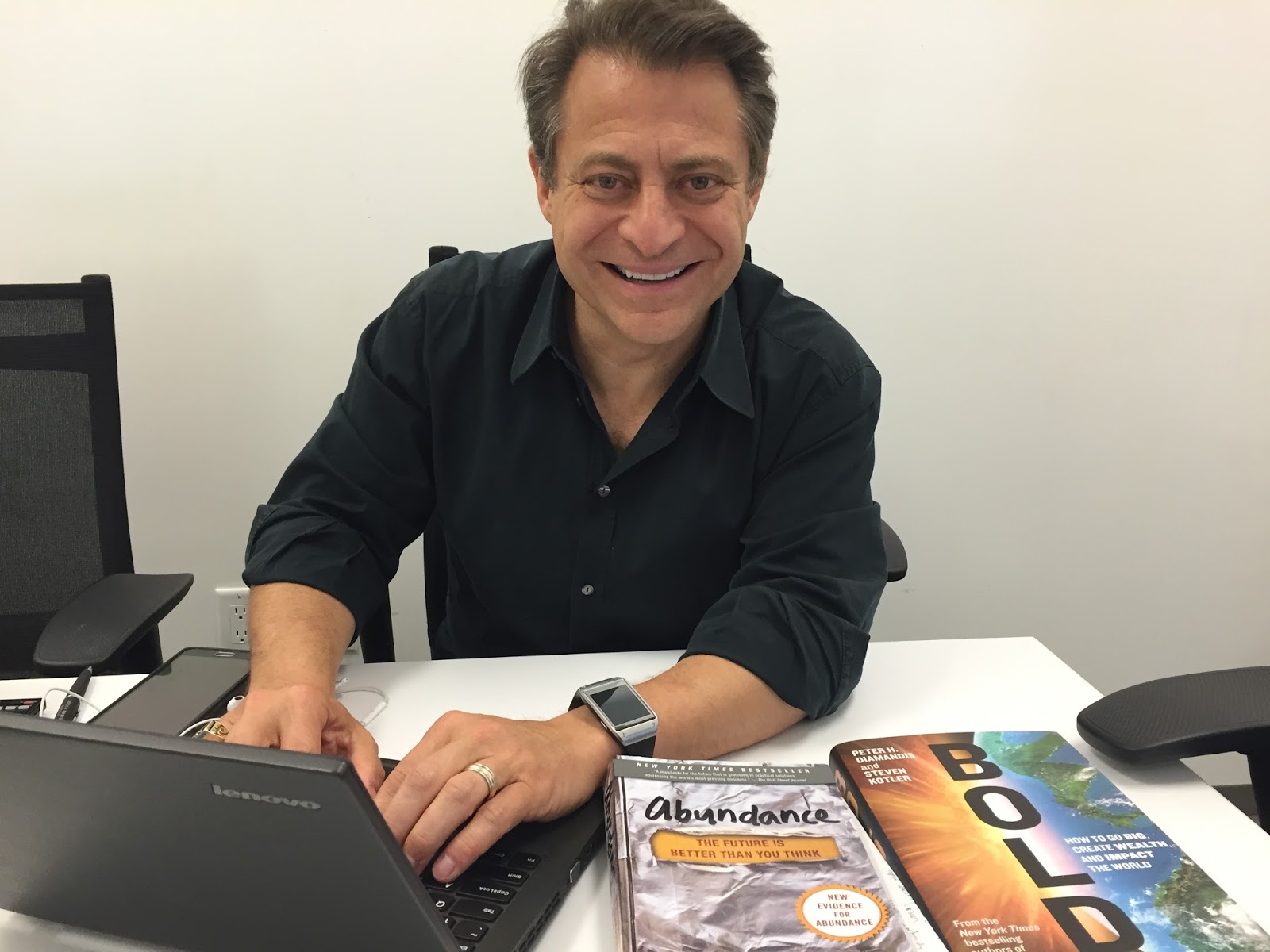
Peter Diamandis - My Conversation with XPRIZE's Founder & Noted Futurist

The world's greatest problems.  Climate change, longer human lifespans testing the limits of society's resources, the downside risks of artificial intelligence (machine v. man).

"All of these things are engineer-able, fixable."

So says Peter Diamandis -- entrepreneur, author, thought leader, visionary, futurist and one of the world's great minds.  "The number of people solving these things has exploded" -- as a result of the pace of new technologies enabling mass, democratized participation.  That's why Diamandis is an eternal optimist who preaches his thoughtful, inspiring -- and frequently convincing -- gospel to the world (literally) via an endless string of ambitious, audacious and passion-fueld mega-endeavors.

After all, Diamandis is Founder and Chairman of the XPRIZE and XPRIZE Foundation, to which he devotes about 30% of his time.  But, when he's not sleeping (which I can't imagine he does much), he today also splits his time with (1) Singularity University (which he co-founded with noted futurist Ray Kurzweil), (2) Human Longevity, Inc., a company he also co-founded that focuses on extending the healthy human lifespan, (3) Planetary Resources, Inc, yet another company he co-founded that has the simple "everyday" ambition of mining asteroids via spacecrafts that also have earth-based agricultural applications, and (4) journalist (he has written multiple best-sellers), speaker (he travels the globe), advisor (serving on boards of some of the most innovative society-engagement technology companies in the world, including virtual reality (VR) companies Oculus and Magic Leap), and educator (he runs and leads executive thought leadership courses).  This is just a partial list of his endeavors.

And, I thought I had a lot on my plate!

Yesterday, I had the special opportunity to sit down one-on-one with Peter at his offices at the XPRIZE Foundation.  I had no agenda (both figuratively and literally).  No script.  Just wanted to learn more about his views on these massive, daunting global issues.  And also get his views on the new world of media, story-telling, and increasingly immersive and virtual social engagement and interaction.  He was engaging, generous with his time, charming, convincing.  I hopped from topic to topic during this hour -- and we touched upon all of these issues and more.  One of the most thought-provoking discussions I have had in my life.

And, here it is -- Peter's thoughts on those subjects.  All sentences with quotation marks and that are  italicized and in bold are direct quotes (I frantically took copious notes).  I'll start with the brave new -- and frequently daunting -- digital media world (especially focusing on VR's total immersion and what he calls today's "Hyper Connectivity").

I.  ON VIRTUAL REALITY

-- VR "will lead to brand new virtual worlds, virtual communities, across all ages."

-- Second Life (the virtual world global game phenomenon) pointed the way to VR, but "VR is fully immersive.  You will feel."

II.  ON THE DOWNSIDE RISKS ASSOCIATED WITH VR, TOTAL IMMERSION & TECHNOLOGY-CHANGING HUMAN INTERACTION

-- I asked him about the deep societal risks of VR's total immersion, some of which include (1) feeling too much (imagine your kids playing "Call of Duty" in a VR world where the combat (and killing) become real to your brain and body, and (2) being used in the wrong hands (imagine terrorist groups like ISIS leveraging VR as core components of their engagement and intimidation strategies).

-- His responses: "You can't change it" (i.e., the reality of new technologies).  It changes you."  "It changes social norms -- how we interact."  Technology "re-wires how society interacts, even how our brain interacts, even the plasticity of the brain."

"Whether it is good or bad.  It just is."

-- And, that thought -- i.e., "It just is" -- is at the core of Peter's mind-set.  There is no judgment about how things are today in the world across all issues.  "It just is."  So, he concerns himself with thinking about how societies can mitigate those risks -- and "fix" the world -- and "better" the world.

-- After all, Peter underscores that "technology has always done these things."  "And what's to say that our interactions 50 years ago were better?"  "They were just 'different.'"  He "is absolutely positive that the same conversations would have taken place in the age of the Gutenberg Press."

-- He cites Steven Pinker's book "The Better Angels of Our Nature" that concludes that -- contrary to widely-held ... and media-propagated global belief (he doesn't watch traditional news outlets) -- we are living in the most peaceful time in human history.  He points out that in medieval times, different tribes essentially thought of others as being non-human -- which enabled violence and killing with emotional detachment.  "But communication has made us understand how inter-related we are."

-- I asked him about the transformational nature of our increasing virtual social interaction and "always on" information exchange via social media that has inundated our lives and the lives of our kids.  What he calls "Hyper Connectivity."

-- He underscored that Hyper Connectivity leads also to what he calls "Hyper Transparency" -- "the ability to know anything, anytime, anywhere" -- which, he believes, ultimately is a good thing and leads to a safer world (even amidst its frequently seeming daunting and brain-altering impacts).

III.  ON ARTIFICIAL INTELLIGENCE (AI) AND MACHINE V. MAN

-- I asked about his concerns about AI-driven machine turning on its human creators via the not-too-distant expected singularity (which media recently depicted in the excellent "must see" movie Ex Machina).

-- That is a Hollywood sensationalist myth, in his view.  He is an optimist that AI will be harnessed for good.

IV.  ON CLIMATE CHANGE

-- He is absolutely certain that we have the ability to solve climate change.

-- As an example, he says we have the technology today that can block a certain percentage of the sun's rays.  "Structurally, that is not difficult to do."  The real question is rather whether society has the will to implement such technologies.

V.  ON EXTENDING HUMAN LIFESPANS AND AN AGING AND EVER-GROWING GLOBAL SOCIETY THAT TAXES THE LIMITS OF EARTH RESOURCES

-- First, he points out that his friend Elon Musk is actually concerned about long-term shrinking global population numbers.

-- The goal of new life extending technology (including his company's) is not simply to extend life.  Rather, it's about extending the quality of life, without over-populating the planet.

-- "The goal is not just living older.  It's living better."

-- As an example of his optimism about technology's potential with human lifespans, he points out that many humans retire at the peak of their professional lives.  And, he asks me to imagine if that wasn't the case.  "That would increase the GNP of a nation substantially."


After all, "all of these things are engineer-able, fixable."


Kamis, 18 Juni 2015

Virtual Reality Update - Latest Developments - Manatt Digital Media Newsletter


June 17, 2015

Manatt Digital Media – June Newsletter: Virtual Reality Update

“VR technology will transform every industry over the next decade or two, just as the Internet was nascent twenty years ago but now is ubiquitous.”—The River Manifesto
In MDM’s previous newsletter on Virtual Reality (VR), we covered some of the basics and gave an overview of the VR landscape. Since then, we have continued to immerse ourselves in the space, and engage with and advise some of its foremost leaders. In this month’s newsletter, we share with you insights from these experiences and innovators and from VR’s countless, game-changing applications—from games and media and entertainment to education, travel, healthcare and beyond. 

VR—Power, Potential, Risks . . .

By Peter Csathy
Earlier this month, I moderated a VR and augmented reality (AR) panel at the SLUSH Future Brunch, hosted by organizers of Helsinki’s “must know” SLUSH digital media and tech conference held annually in November. My panel included some of the most important thought leaders and innovators in the VR space—Mike Rothenberg of Rothenberg Ventures (in which Manatt Venture Fund is an investor)—Rothenberg runs the first VR accelerator, called River; Danny Gabai of Vice Media, which produces some of the most inspired VR “experiences” to date; Andy Cochrane of Mirada Studios; and Neville Spiteri of WEVR. We covered a lot of ground during the session, including:

1. The state of VR today—and the prospects for the future—with all on the panel predicting mass consumer adoption of tens of millions of VR headsets within a couple of years (MDM completely agrees with that assessment). Read more

VR—The Engine of Empathy and Real Social Change

By Peter Csathy
MDM recently visited Silicon Valley—and one highlight of that trip was pioneering VR company Jaunt (more on Jaunt in the profile below). Jaunt demonstrated just some of VR’s possibilities. Yes, media and entertainment. Yes, games and adventure. Those are obvious and frequently discussed. Read more

Jaunt, VR and the Future of Media and Entertainment

By Peter Csathy
On MDM’s recent trip to Jaunt, CEO Jens Christensen first sat me down in the Jaunt demo studio (pictured here to the left),where I sat through and experienced four different demos. First demo: On the stage at a recent Paul McCartney concert (yes, these will sell big time). Second demo: Extreme climbing and parachuting off cliffs in Yosemite and other extreme lands. Third demo: Immersed as a character in a horror movie (complete with a blanket thrown over my head by one of the demons that made my entire body flinch). Fourth demo: A CGI EDM-driven segment. Read more

River—Accelerating Virtual Reality Start-Ups

By  Mary Ermitanio
In December 2014, two-year-old fund Rothenberg Ventures first opened its doors to applications for River, its new virtual reality-focused accelerator. The three-month program aims to be the “world’s VR classroom” and offers start-ups $100,000 investments, mentorship by industry veterans, and office space at the Rothenberg Ventures’ 8,000-square-foot space in San Francisco.  Read more

VNTANA Extends Live Experiences Globally

By Sarah Chambless
Earlier this year, MDM visited the Santa Monica offices of VNTANA. Tucked away in the rear parking lot of a multiuse space near Bergamot Station, VNTANA enables immersive, multilocation live experiences through high-definition, real-time hologram technology. Read more

MDM Spotlight Profile

Sarah Chambless leads Manatt Digital Media’s Virtual Reality initiatives. Sarah specializes in start-up company formation, early-stage finance, venture capital investment transactions and private company mergers and acquisitions. She advises emerging tech companies in digital media, technology, consumer products, social enterprise and nonprofit sectors, and represents both emerging companies and venture capital investors in seed and venture capital financings. She also has experience in fund formation and joint ventures. Prior to joining Manatt, she taught elementary school in Compton, California, as a Teach for America corps member. 
View her full profile here.

Selasa, 16 Juni 2015

VR & AR - Power, Potential, Risks ... Thoughts of Leading Innovators In This Immersive Space

Last week, I moderated a virtual reality (VR) and augmented reality (AR) panel at the SLUSH Future Brunch, hosted by organizers of Helsinki's "must know" SLUSH digital media and tech conference held annually in November.  My panel included some of the most important thought leaders and innovators in the VR space – (i) Mike Rothenberg of Rothenberg Ventures (in which Manatt Venture Fund is an investor) -- Rothenberg runs the first VR accelerator called River); (ii) Danny Gabai of Vice Media (producers of some of the most inspired VR “experiences” to date, including "Clouds Over Sidra" about which I wrote previously); (iii) Andy Cochrane of Mirada Studios; and (iv) Neville Spiteri of WEVR.  We covered a lot of ground during the session, including:

(1)         The state of VR today – and the prospects for the future – with all on the panel predicting mass consumer adoption of tens of millions of VR headsets within a couple of years (I completely agree with that assessment -- and my team and I at Manatt Digital Media are working with a number of VR companies to accelerate that pace);

(2)         The fact that it is available content, rather than “ready for prime time” hardware, that is the bottle-neck for such mass adoption right now;

(3)         The unique power and opportunity for VR not only in the obvious areas of story-telling, but also for (i) live events (think of yourself being transported to your favorite music artist’s live event and sitting in the front row – would you pay for that?  I would – and just think of the potential of this new revenue stream for the music business), (ii) travel (being immersed in a foreign land rather than watching videos on a box), (iii) education (think of the power and potential in the classroom) and (iv) empathy and social change (e.g., "Clouds Over Sidra");

(4)         Andy Cochrane emphasized that the distinction between VR and AR is blurred and artificial – and rather than thinking of those two as being distinct concepts, they together represent what he singly calls “immersive and interactive” experiences;

(5)         Andy also underscored that we should be careful of placing VR experiences into a box like “VR gaming”, because VR experiences are entirely different in terms of structure and simply cannot follow typical games branches;

(6)         Mike Rothenberg, while massively bullish on the overall VR opportunity, also pointed out significant risks associated with VR experiences.  Motion sickness is the most discussed right now (but is fast being addressed by the industry).  But, less discussed – and significantly problematic – is the sheer overwhelming, and potentially extremely dangerous, immersion into high intensity contexts.  Think the video game “Call of Duty.”  Imagine the potential post-traumatic stress disorder (PTSD) that could flow from being placed directly into battle and violence.  These risks are real – and companies are rising up now to address those dangers.  Think further of the potential for VR abuse in the hands of those with malevolent intentions (think ISIS).  It is for these reasons, that Mike anticipates a need for real regulations in this area.


It was a fascinating discussion cut short only by the need to end the event.